A Galois Field Arithmetic Primer
- Introduction
- A Galois Field Introduction by Example
- Base Galois Fields
- A Real World Example of a Base Galois Field
- GF(2)
- Extended Galois Fields
- Extended Galois Field Addition
- Extended Galois Field Multiplication
- A Field Defining Irreducible Polynomial
- A Primitive Polynomial
- From Abstract Alpha to a Real Value
- Selecting Primitive Polynomials
- The Benefit of Primitive Polynomials
- Linear Feedback Shift Register
- Multiplication through Addition of Exponents
- References
- Footnotes
Introduction
In my blog post about Reed-Solomon coding, I used regular integers for all calculations. These are impractical for a real-world implementation, but since everybody knows integer math since first grade, it made things easier to learn things one step at a time.
Instead of working with pure integers, actual Reed-Solomon implementations use elements from a Galois or finite field as symbols.
I’ve been sitting on implementing and writing about a Reed-Solomon decoder for almost 4 years now1, and I’m still not quite there, but a first step is to have enough Galois field understanding so that the lack of it isn’t an obstacle. That’s what this blog is about. Don’t expect a solid theoretical treatise, you can find many of those as part of university courses, but something that is sufficient to refer back to in the future when I’ve forgotten some of the details.
If you want to get a deeper understanding, check out the references at the bottom.
A Galois Field Introduction by Example
In mathematics, a field is a set of elements for which addition, subtraction, multiplication and division operations have been defined, with properties that we take for granted when dealing with rational or real numbers, such as the associative and distributive properties2, the rules for adding and multiplying with 0, and so forth.
For rational or real numbers, the number of elements in the field is infinite. A Galois field only has a limited number of elements, yet still has these kind of operations and properties.
A good example of a Galois field is \(\text{GF}(5)\) which has integer numbers 0 to 4 as elements. Addition, subtraction, and multiplication work the same as for regular integers but each such operation is followed by a modulo 5 operation.
Here are a few example operations in \(\text{GF}(5)\):
\[\begin{align} 1 + 3 = (1+3) \bmod 5 = 4 \bmod 5 = 4 \\ 2 + 6 = (2+6) \bmod 5 = 8 \bmod 5 = 3 \\ 3 \cdot 4 = (3 \cdot 4) \bmod 5 = 12 \bmod 5 = 2 \\ \end{align}\]Division is a bit less intuitive. It is defined as the multiplication by the inverse of the divisor:
\[\frac{a}{b} = a \cdot b^{-1}\]One way of finding the multiplicative inverse of the divisor is by multiplying it with all possible elements and checking if the result is 1.
Let’s say we want to do \(2/3\) in \(\text{GF}(5)\). We need to find \(3^{-1}\) so that \(3 \cdot 3^{-1} = 1\). There are 5 different options \(0,1,2,3,4\):
\[\begin{align} (3 \cdot 0) \bmod 5 = 0 \\ (3 \cdot 1) \bmod 5 = 3 \\ \boldsymbol{(3 \cdot 2) \bmod 5 = 1} \\ (3 \cdot 3) \bmod 5 = 4 \\ (3 \cdot 4) \bmod 5 = 2 \\ \end{align}\]We can see that \((3 \cdot 2)\bmod 5 = 1\), so \(3^{-1}=2\).
And thus:
\[2/3 = 2 \cdot 3^{-1} = (2 \cdot 2) \bmod 5 = 4\]There are other ways to calculate the multiplicative inverse. For simple cases, you can use Fermat’s Little Theorem, which says:
\[a^{p-1} \equiv 1 \pmod{p}\]or, after dividing both sides by \(a\):
\[a^{p-2} \equiv a^{-1} \pmod{p}\]In our example \(a=3\) and \(p=5\), so:
\[3^{-1} = 3^{5-2} = 3^3 = 27\] \[27 \pmod{5} = 2\]A more general algorithm is the Extended Euclidean Algorithm.
Base Galois Fields
The example above is one of a base Galois field
\[\text{GF}(p)\]\(p\) is the base number of a one-dimensional mathematical universe. In a base Galois field, \(p\) must always be a prime number, otherwise the division operation would be ill defined.
For example, if we’d set \(p=6\) and tried to find the multiplicative inverse of 2, we’d get the following:
\[\begin{align} (2 \cdot 0) \bmod 6 = 0 \\ (2 \cdot 1) \bmod 6 = 2 \\ (2 \cdot 2) \bmod 6 = 4 \\ (2 \cdot 3) \bmod 6 = 0 \\ (2 \cdot 4) \bmod 6 = 2 \\ (2 \cdot 5) \bmod 6 = 4 \\ \end{align}\]There’s no solution with a result of 1. Since there’s at least one element for which a multiplicative inverse doesn’t exist, you can’t create a field for \(p=6\) and thus \(\text{GF}(6)\) can’t exist.
Another issue for \(p=6\) is that you can get a result of 0 when multiplying 2 non-zero numbers:
\[2 \cdot 3 \pmod{6} = 6 \pmod{6} = 0\]That’s behavior unbecoming of a proper field!
A Real World Example of a Base Galois Field
Since a base Galois field must have a prime number of elements, only \(\text{GF}(2)\) maps directly to the zeros and ones of digital logic; all other fields have an odd number of elements. Still, there are some real-world cases where these kind of Galois fields are used: the Wikipedia article on Reed-Solomon error correction has an example that uses \(\text{GF}(929)\), a field that is used for coding PDF417 bar codes.
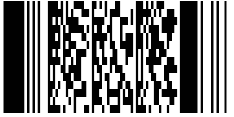
© Markus.Jungbauer - Wikipedia

Modulo 929 calculations are fine for bar codes, you only need to process a few per second at most, but they’re not something you’d want to use for high speed communication protocols that run at rates of gigabits or bytes per second.
GF(2)
Before taking the next step, let’s first look at the only base field that maps neatly to ones and zeros: \(\text{GF}(2)\). The binary Galois field only has 2 symbols: 0 and 1.
It has the following addition table:
\[\begin{align} (0 + 0) \bmod 2 = 0 \\ (0 + 1) \bmod 2 = 1 \\ (1 + 0) \bmod 2 = 1 \\ (1 + 1) \bmod 2 = 0 \\ \end{align}\]And this is the multiplication table:
\[\begin{align} (0 \cdot 0) \bmod 2 = 0 \\ (0 \cdot 1) \bmod 2 = 0 \\ (1 \cdot 0) \bmod 2 = 0 \\ (1 \cdot 1) \bmod 2 = 1 \\ \end{align}\]Addition maps to a XOR and multiplication to an AND gate. Another property of note is that subtraction is the same as addition.
These are promising properties for a hardware implementation.
Extended Galois Fields
From a base Galois field \(\text{GF}(p)\) one can construct an extended Galois field
\[\text{GF}(p^n)\]\(p\) is still the size of mathematical universe in one dimension and prime. \(n\) is the number of dimensions. The total number of elements in the extended Galois field is \(p^n\). An element \(a\) of such a Galois field could be written as a vector:
\[( a_{n-1}, \cdots, a_1, a_0 )\]Or as a polynomial:
\[a(x) = a_{n-1} x^{n-1} + \cdots + a_1 x + a_0\]When polynomials are used to represent elements of an extended Galois field, don’t think of \(x\) as a variable that you plug numbers into. In this context, the powers \(1, x, x^2, \cdots, x^{n-1}\) are mostly a formal expression to separate the dimensions. Think of it how integer \(5367\) can be written as \(5 \cdot 1000 + 3 \cdot 100 + 6 \cdot 10 + 7\). That analogy breaks when coeffients for integers exceed 9, because unlike Galois field coefficients, you get spillover to the next power of 10.
For algorithms that are implemented in hardware, it’s extremely common to deal with \(\text{GF}(2^n)\), and \(\text{GF}(2^8)\) especially: this results in 8 dimensions of values 0 and 1 which conveniently maps to a byte.
You’ll sometimes see an extended Galois field written with argument in parenthesis worked out, e.g. \(\text{GF}(2^8)\) written as \(\text{GF}(256)\). This is not an ambiguous notation: you can infer this to be a Galois field extension because 256 is not a prime, but my personal preference is to always use the \(\text{GF}(2^8)\) notation.
All Galois fields require an addition, subtraction, multiplication, and division operation. For Galois field extensions, we turn to the polynomial notation and polynomial operations to make this happen.
Extended Galois Field Addition
To add 2 elements \(a\) and \(b\):
\[\begin{align} (a_3 x^3 + a_2 x^2 + a_1 x + a_0) + (b_3 x^3 + b_2 x^2 + b_1 x + b_0) \\ = (a_3+b_3) x^3 + (a_2 + b_2) x^2 + (a_1 + b_1) x + (a_0 + b_0) \end{align}\]The base Galois field rules apply for the addition of each of the terms.
Here’s a \(\text{GF}(2^4)\) example:
\[(1,0,0,1) + (0,0,1,1) =\] \[( 1 x^3 + 0 x^2 + 0 x + 1 ) + ( 0 x^3 + 0 x^2 + 1 x + 1 ) =\] \[(1+0) x^3 + (0+0) x^2 + (0+1) x + (1+1) =\] \[1 x^3 + 0 x^2 + 1 x + 0 =\] \[(1,0,1,0)\]Note how for the last term \((1+1) = 0\). That’s the base \(\text{GF}(2)\) operation.
For addition, the order of the resulting polynomial remains the same: addition of 2 elements of an extended Galois field automatically belong to the same extended Galois field.
Extended Galois Field Multiplication
Like base Galois field multiplication, the extended version uses a multiplication followed by division and retaining the remainder. Like addition, this is done with polynomials.
\[m(x) = a(x) \cdot b(x) \pmod{f(x)}\]The modulo operation is necessary to ensure that the result of the multiplication is a polynomial with the same maximum order as the operands. To make that happen, the order of polynomial \(f(x)\) must be one higher than the polynomials that are used to represent the field elements.
For example, for \(GF(2^4)\), the elements have 4 dimensions and are represented with polynomials with an order of 3: \(a_3 x^3 + a_2 x^2 + a_1 x + a_0\). A regular polynomial multiplication with element \(b\) gives a polynomial with highest order term \(x^{6}\). The modulo operation with a polynomial with maximum term \(x^4\) will reduce the result back to one with maximum term \(x^3\).
A Field Defining Irreducible Polynomial
The following requirements are key for a field defining polynomial for \(\text{GF}(p^n)\):
- the polynomial is of order \(n\): \(f(x) = x^n + f_{n-1} x^{n-1} + \cdots + f x + f_0\).
- the coefficient of \(x^n\) is always 1, even if \(p > 2\). The polynomial is monic.
- the remaining coefficients are from the base field \(\text{GF}(p)\).
-
the polynomial is irreducible in the field of \(\text{GF}(p)\).
An irreducible polynomial can not be factored into multiple lower order polynomials.
Note the similarity with base Galois field \(\text{GF}(p)\), where \(p\) must be a prime number, one that can not be factored into multiple smaller integers.
Pay attention to the part where I write that it needs to be irreducible in the field of \(\text{GF}(p)\). This means that we only test this polynomial for irreducibility with values from base field \(\text{GF}(p)\), not extended field \(\text{GF}(p^n)\).
One thing to test when checking for irreducibility is that none of the base Galois field elements are a root of \(f(x)\). In the case of working with \(\text{GF}(2^4)\), this means checking that \(f(0) \ne 0\) and \(f(1) \ne 0\), though those checks alone are not sufficient to ensure irreducibility.
Much like the earlier example where \(2 \cdot 3 \pmod{6} = 0\), a reducible polynomial makes it impossible to properly define extended Galois field operations.
For example, if for \(\text{GF}(2^4)\) we select reducible polynomial \(f(x) = x^4 + 1\) as defining polynomial3, then we get the following multiplication:
\[\begin{gather} ( x^3 + x^2 + x + 1) (x + 1) \pmod{x^4 + 1} = \\ (1 \cdot 1) x^4 + (1 \cdot 1 + 1 \cdot 1) x^3 + (1 \cdot 1 + 1 \cdot 1) x^2 + (1 \cdot 1 + 1 \cdot 1) x + (1 \cdot 1) \pmod{x^4 + 1} = \\ x^4 + (1 + 1) x^3 + (1 + 1) x^2 + (1 + 1) x + 1 \pmod{x^4 + 1} = \\ x^4 + 1 \pmod{x^4 + 1} = \\ 0 \end{gather}\]In other words, we have again a case where multiplying non-zero elements results in zero, which is not allowed for a field.
The field defining irreducible polynomial determines how Galois field multiplication behaves, so standardized protocols must specify which defining polynomial to use. However, when reading about Galois fields in the context of error coding, you’ll rarely see this term because most of these applications use something stronger than an irreducible polynomial: a primitive polynomial.
A Primitive Polynomial
A primitive polynomial is an irreducible polynomial \(f(x)\) with one additional characteristic: it defines a field for which the powers of a primitive element \(\alpha\) generate all non-zero elements of the field.
What does this mean? And what is \(\alpha\) anyway?
\(\alpha\) is defined as an element of \(\text{GF}(p^n)\) that satisfies the following equation:
\[f(\alpha) = 0\]In other words, \(\alpha\) is a root of \(f(x)\).
It is crucial to understand that the equation above is the formal definition of \(\alpha\). There are multiple values from \(\text{GF}(p^n)\) that can serve as \(\alpha\), but right now, we don’t care about that: \(\alpha\) is a placeholder, an abstract element. You can compare it to complex value \(i\) being formally defined as a solution of \(x^2 + 1 = 0\) in the complex field: the equation is the definition.
If \(f(x)\) is irreducible, how can \(\alpha\) be a root of it? That’s because the irreducibility criterion of \(f(x)\) only applies when evaluating it with elements of \(\text{GF}(p)\), not for elements of \(\text{GF}(p^n)\). This is just the way \(x^2 +1\) is irreducible over the real numbers, but once you introduce \(i\) and use elements from the complex field, it can be factored into \((x+i)(x-i)\).
\(f(x)\) is a monic polynomial of order \(n\):
\[f(x) = x^n + f_{n-1} x^{n-1} + \cdots + f_1 x + f_0\]Using the definition of \(\alpha\):
\[f(\alpha) = \alpha^n + f_{n-1} \alpha^{n-1} + \cdots + f_1 \alpha + f_0 = 0\]Simple rearrangement gives this:
\[\alpha^n = - ( f_{n-1} \alpha^{n-1} + \cdots + f_1 \alpha + f_0 )\]In the case of \(\text{GF}(2^n)\), subtraction is the same as addition, so you get this:
\[\alpha^n = f_{n-1} \alpha^{n-1} + \cdots + f_1 \alpha + f_0\]We have derived a reduction rule that tells us how to deal with \(\alpha^i\) when \(i \ge n\).
Let’s put this into practice…
\(\text{GF}(2^4)\) has this primitive polynomial:
\[f(x) = x^4 + x^1 + 1\]Using the reduction formula
\[\alpha^4 = \alpha + 1\]we can construct all non-zero elements of the field using only exponentials:
| Power | Split | Substitution | Multiply | \(\pmod{f(x)}\) |
|---|---|---|---|---|
| \(\alpha^{0}\) | \(1\) | \(1\) | \(1\) | \(1\) |
| \(\alpha^{1}\) | \(\alpha\) | \(\alpha\) | \(\alpha\) | \(\alpha\) |
| \(\alpha^{2}\) | \(\alpha^{2}\) | \(\alpha^{2}\) | \(\alpha^{2}\) | \(\alpha^{2}\) |
| \(\alpha^{3}\) | \(\alpha^{3}\) | \(\alpha^{3}\) | \(\alpha^{3}\) | \(\alpha^{3}\) |
| \(\alpha^{4}\) | \(\alpha^{4}\) | \(\alpha + 1\) | \(\alpha + 1\) | \(\alpha + 1\) |
| \(\alpha^{5}\) | \(\alpha^{4} \cdot \alpha\) | \((\alpha + 1) \cdot \alpha\) | \(\alpha^{2} + \alpha\) | \(\alpha^{2} + \alpha\) |
| \(\alpha^{6}\) | \(\alpha^{5} \cdot \alpha\) | \((\alpha^{2} + \alpha) \cdot \alpha\) | \(\alpha^{3} + \alpha^{2}\) | \(\alpha^{3} + \alpha^{2}\) |
| \(\alpha^{7}\) | \(\alpha^{6} \cdot \alpha\) | \((\alpha^{3} + \alpha^{2}) \cdot \alpha\) | \(\alpha^{4} + \alpha^{3}\) | \(\alpha^{3} + \alpha + 1\) |
| \(\alpha^{8}\) | \(\alpha^{7} \cdot \alpha\) | \((\alpha^{3} + \alpha + 1) \cdot \alpha\) | \(\alpha^{4} + \alpha^{2} + \alpha\) | \(\alpha^{2} + 1\) |
| \(\alpha^{9}\) | \(\alpha^{8} \cdot \alpha\) | \((\alpha^{2} + 1) \cdot \alpha\) | \(\alpha^{3} + \alpha\) | \(\alpha^{3} + \alpha\) |
| \(\alpha^{10}\) | \(\alpha^{9} \cdot \alpha\) | \((\alpha^{3} + \alpha) \cdot \alpha\) | \(\alpha^{4} + \alpha^{2}\) | \(\alpha^{2} + \alpha + 1\) |
| \(\alpha^{11}\) | \(\alpha^{10} \cdot \alpha\) | \((\alpha^{2} + \alpha + 1) \cdot \alpha\) | \(\alpha^{3} + \alpha^{2} + \alpha\) | \(\alpha^{3} + \alpha^{2} + \alpha\) |
| \(\alpha^{12}\) | \(\alpha^{11} \cdot \alpha\) | \((\alpha^{3} + \alpha^{2} + \alpha) \cdot \alpha\) | \(\alpha^{4} + \alpha^{3} + \alpha^{2}\) | \(\alpha^{3} + \alpha^{2} + \alpha + 1\) |
| \(\alpha^{13}\) | \(\alpha^{12} \cdot \alpha\) | \((\alpha^{3} + \alpha^{2} + \alpha + 1) \cdot \alpha\) | \(\alpha^{4} + \alpha^{3} + \alpha^{2} + \alpha\) | \(\alpha^{3} + \alpha^{2} + 1\) |
| \(\alpha^{14}\) | \(\alpha^{13} \cdot \alpha\) | \((\alpha^{3} + \alpha^{2} + 1) \cdot \alpha\) | \(\alpha^{4} + \alpha^{3} + \alpha\) | \(\alpha^{3} + 1\) |
| \(\alpha^{15}\) | \(\alpha^{14} \cdot \alpha\) | \((\alpha^{3} + 1) \cdot \alpha\) | \(\alpha^{4} + \alpha\) | \(1\) |
In the table above, \(\alpha^4\) is reduced with the reduction formula, and each row after is reduced by the row before it. The 2 factors are then multiplied which results in a maximum order of 4. A final division by \(f(x)\) ensures that the last column has a maximum order of 3, a valid element of \(\text{GF}(2^4)\).4
The key observation is that the last column goes through all 15 non-zero elements.
Here is what happens when you use an irreducible polynomial that is not primitive:
\[f(x) = x^4 + x^3 + x^2 + x + 1\]| Power | Split | Substitution | Multiply | \(\pmod{f(x)}\) |
|---|---|---|---|---|
| \(\alpha^{0}\) | \(1\) | \(1\) | \(1\) | \(1\) |
| \(\alpha^{1}\) | \(\alpha\) | \(\alpha\) | \(\alpha\) | \(\alpha\) |
| \(\alpha^{2}\) | \(\alpha^{2}\) | \(\alpha^{2}\) | \(\alpha^{2}\) | \(\alpha^{2}\) |
| \(\alpha^{3}\) | \(\alpha^{3}\) | \(\alpha^{3}\) | \(\alpha^{3}\) | \(\alpha^{3}\) |
| \(\alpha^{4}\) | \(\alpha^{4}\) | \(\alpha^{3} + \alpha^{2} + \alpha + 1\) | \(\alpha^{3} + \alpha^{2} + \alpha + 1\) | \(\alpha^{3} + \alpha^{2} + \alpha + 1\) |
| \(\alpha^{5}\) | \(\alpha^{4} \cdot \alpha\) | \((\alpha^{3} + \alpha^{2} + \alpha + 1) \cdot \alpha\) | \(\alpha^{4} + \alpha^{3} + \alpha^{2} + \alpha\) | \(1\) |
| \(\alpha^{6}\) | \(\alpha^{5} \cdot \alpha\) | \((1) \cdot \alpha\) | \(\alpha\) | \(\alpha\) |
| \(\alpha^{7}\) | \(\alpha^{6} \cdot \alpha\) | \((\alpha) \cdot \alpha\) | \(\alpha^{2}\) | \(\alpha^{2}\) |
| \(\alpha^{8}\) | \(\alpha^{7} \cdot \alpha\) | \((\alpha^{2}) \cdot \alpha\) | \(\alpha^{3}\) | \(\alpha^{3}\) |
| \(\alpha^{9}\) | \(\alpha^{8} \cdot \alpha\) | \((\alpha^{3}) \cdot \alpha\) | \(\alpha^{4}\) | \(\alpha^{3} + \alpha^{2} + \alpha + 1\) |
| \(\alpha^{10}\) | \(\alpha^{9} \cdot \alpha\) | \((\alpha^{3} + \alpha^{2} + \alpha + 1) \cdot \alpha\) | \(\alpha^{4} + \alpha^{3} + \alpha^{2} + \alpha\) | \(1\) |
| \(\alpha^{11}\) | \(\alpha^{10} \cdot \alpha\) | \((1) \cdot \alpha\) | \(\alpha\) | \(\alpha\) |
| \(\alpha^{12}\) | \(\alpha^{11} \cdot \alpha\) | \((\alpha) \cdot \alpha\) | \(\alpha^{2}\) | \(\alpha^{2}\) |
| \(\alpha^{13}\) | \(\alpha^{12} \cdot \alpha\) | \((\alpha^{2}) \cdot \alpha\) | \(\alpha^{3}\) | \(\alpha^{3}\) |
| \(\alpha^{14}\) | \(\alpha^{13} \cdot \alpha\) | \((\alpha^{3}) \cdot \alpha\) | \(\alpha^{4}\) | \(\alpha^{3} + \alpha^{2} + \alpha + 1\) |
| \(\alpha^{15}\) | \(\alpha^{14} \cdot \alpha\) | \((\alpha^{3} + \alpha^{2} + \alpha + 1) \cdot \alpha\) | \(\alpha^{4} + \alpha^{3} + \alpha^{2} + \alpha\) | \(1\) |
This time around, the pattern repeats every 5 elements: a non-primitive polynomial does not construct the whole field with just exponentiation of \(\alpha\).
From Abstract Alpha to a Real Value
So far, \(\alpha\) has been an abstract element that hasn’t been assigned a real value. That can be trivially fixed by assigning \(\alpha\) a value of \(x\):
That’s really it!
| Power | \(\pmod{f(x)}\) | \(\alpha \to x\) | Binary |
|---|---|---|---|
| \(\alpha^{0}\) | \(1\) | \(1\) | 0001 |
| \(\alpha^{1}\) | \(\alpha\) | \(x\) | 0010 |
| \(\alpha^{2}\) | \(\alpha^{2}\) | \(x^{2}\) | 0100 |
| \(\alpha^{3}\) | \(\alpha^{3}\) | \(x^{3}\) | 1000 |
| \(\alpha^{4}\) | \(\alpha + 1\) | \(x + 1\) | 0011 |
| \(\alpha^{5}\) | \(\alpha^{2} + \alpha\) | \(x^{2} + x\) | 0110 |
| \(\alpha^{6}\) | \(\alpha^{3} + \alpha^{2}\) | \(x^{3} + x^{2}\) | 1100 |
| \(\alpha^{7}\) | \(\alpha^{3} + \alpha + 1\) | \(x^{3} + x + 1\) | 1011 |
| \(\alpha^{8}\) | \(\alpha^{2} + 1\) | \(x^{2} + 1\) | 0101 |
| \(\alpha^{9}\) | \(\alpha^{3} + \alpha\) | \(x^{3} + x\) | 1010 |
| \(\alpha^{10}\) | \(\alpha^{2} + \alpha + 1\) | \(x^{2} + x + 1\) | 0111 |
| \(\alpha^{11}\) | \(\alpha^{3} + \alpha^{2} + \alpha\) | \(x^{3} + x^{2} + x\) | 1110 |
| \(\alpha^{12}\) | \(\alpha^{3} + \alpha^{2} + \alpha + 1\) | \(x^{3} + x^{2} + x + 1\) | 1111 |
| \(\alpha^{13}\) | \(\alpha^{3} + \alpha^{2} + 1\) | \(x^{3} + x^{2} + 1\) | 1101 |
| \(\alpha^{14}\) | \(\alpha^{3} + 1\) | \(x^{3} + 1\) | 1001 |
| \(\alpha^{15}\) | \(1\) | \(1\) | 0001 |
It seems dumb to go through the whole \(\alpha\) business when we could have used \(x\) all along, and in practice that’s true: as far as I know, every practical implementation substitutes \(\alpha\) that way.
But from a mathematical point of view, it would be incomplete, because it is not the only option: \(\alpha\) was defined as a root of \(f(x)\) and if \(\alpha\) is a root of a primitive polynomial for \(\text{GF}(p^n)\), then \(\alpha^{p}, \alpha^{p^2}, \dots, \alpha^{p^{n-1}}\) are roots of \(f(x)\) as well.
For our \(\text{GF}(2^4)\) example, that means that all of the following values can be used as a replacement of \(\alpha\):
\[x, x^2, x^4, x^8\]Here’s how \(\alpha^i\) maps for \(\alpha = x^4\):
| Power | \(\pmod{f(x)}\) | \(\alpha \to x^4\) | \(\pmod{f(x)}\) | Binary |
|---|---|---|---|---|
| \(\alpha^{0}\) | \(1\) | \(1\) | \(1\) | 0001 |
| \(\alpha^{1}\) | \(\alpha\) | \(x^{4}\) | \(x + 1\) | 0011 |
| \(\alpha^{2}\) | \(\alpha^{2}\) | \(x^{8}\) | \(x^{2} + 1\) | 0101 |
| \(\alpha^{3}\) | \(\alpha^{3}\) | \(x^{12}\) | \(x^{3} + x^{2} + x + 1\) | 1111 |
| \(\alpha^{4}\) | \(\alpha + 1\) | \(x^{4} + 1\) | \(x\) | 0010 |
| \(\alpha^{5}\) | \(\alpha^{2} + \alpha\) | \(x^{8} + x^{4}\) | \(x^{2} + x\) | 0110 |
| \(\alpha^{6}\) | \(\alpha^{3} + \alpha^{2}\) | \(x^{12} + x^{8}\) | \(x^{3} + x\) | 1010 |
| \(\alpha^{7}\) | \(\alpha^{3} + \alpha + 1\) | \(x^{12} + x^{4} + 1\) | \(x^{3} + x^{2} + 1\) | 1101 |
| \(\alpha^{8}\) | \(\alpha^{2} + 1\) | \(x^{8} + 1\) | \(x^{2}\) | 0100 |
| \(\alpha^{9}\) | \(\alpha^{3} + \alpha\) | \(x^{12} + x^{4}\) | \(x^{3} + x^{2}\) | 1100 |
| \(\alpha^{10}\) | \(\alpha^{2} + \alpha + 1\) | \(x^{8} + x^{4} + 1\) | \(x^{2} + x + 1\) | 0111 |
| \(\alpha^{11}\) | \(\alpha^{3} + \alpha^{2} + \alpha\) | \(x^{12} + x^{8} + x^{4}\) | \(x^{3} + 1\) | 1001 |
| \(\alpha^{12}\) | \(\alpha^{3} + \alpha^{2} + \alpha + 1\) | \(x^{12} + x^{8} + x^{4} + 1\) | \(x^{3}\) | 1000 |
| \(\alpha^{13}\) | \(\alpha^{3} + \alpha^{2} + 1\) | \(x^{12} + x^{8} + 1\) | \(x^{3} + x + 1\) | 1011 |
| \(\alpha^{14}\) | \(\alpha^{3} + 1\) | \(x^{12} + 1\) | \(x^{3} + x^{2} + x\) | 1110 |
| \(\alpha^{15}\) | \(1\) | \(1\) | \(1\) | 0001 |
The binary representation is different than for the \(\alpha = x\), but from a mathematical point of view, it doesn’t really matter.
And, again, in the real world, every one just uses \(\alpha=x\).
Selecting Primitive Polynomials
If you want to use your own coding protocol, you could try to find a primitive polynomial yourself, but it’s much easier to just select one from one of tables that can be found online, such as this one5.
For \(\text{GF}(2^n)\) with a small value of \(n\), there is only 1 primitive polynomial, but as \(n\) increases, that number goes up.
We already saw that \(\text{GF}(2^4)\) has this one:
\[x^4 + x^1 + 1\]And that’s the only one it has. For \(\text{GF}(2^8)\) you have much more options:
\[\begin{gather} x^8 + x^4 + x^3 + x^2 + 1 \\ x^8 + x^5 + x^3 + x^1 + 1 \\ x^8 + x^6 + x^4 + x^3 + x^2 + x^1 + 1 \\ x^8 + x^6 + x^5 + x^1 + 1 \\ x^8 + x^6 + x^5 + x^2 + 1 \\ x^8 + x^6 + x^5 + x^3 + 1 \\ x^8 + x^7 + x^6 + x^1 + 1 \\ x^8 + x^7 + x^6 + x^5 + x^2 + x^1 + 1 \\ \end{gather}\]Modern x86 CPUs have dedicated instructions for \(\text{GF}(2^8)\) operations with the following polynomial:
\[x^8 + x^4 + x^3 + x + 1\]Surprisingly, while this polynomial is irreducible, it is not primitive! It’s used by the Rijndael algorithm, the basis for AES encryption.
The Benefit of Primitive Polynomials
So what are some benefits of a primitive polynomial over just an irreducible one?
Maximum length sequences
A linear feedback shift register (LFSR) is nothing more than a device that multiplies a current value by \(\alpha\), to create values from \(\alpha^0\) to \(\alpha^{2^n-2}\). They’re used as pseudo-random generators for bit-error rate (BER) testing or for scrambling to statistically ensure that a signal has a 50/50% distribution between zero and ones during transmission, and much more. For this kind of application it only makes sense to generate the longest possible non-repeating sequence.
Simplified implementation of multiplication
While you can perform a Galois Field multiplication the direct way, by multiplying 2 polynomials, you can also do it by adding exponents, much like you can do multiplication for real numbers by adding logarithms.
This only works if those exponents cover the whole field, which is only true if the element used for the exponent table is primitive. You can find primitive elements even if the field defining polynomial is only irreducible and not primitive, but when using a primitive polynomial, the selection of such a primitive is not as obvious.
Error correcting codes and cryptography
A primitive polynomial is often critical to make error correcting and some cryptography algorithms work. Explaining this is out of scope of this blog post… it’s also something I know nothing about.
Linear Feedback Shift Register
Looking back at a previous table of the \(\text{GF}(2^4)\) example, the shift register action is easy to see when you start with a register value of 0001:
| Power | \(\pmod{f(x)}\) | \(\alpha \to x\) | Binary |
|---|---|---|---|
| \(\alpha^{0}\) | \(1\) | \(1\) | 0001 |
| \(\alpha^{1}\) | \(\alpha\) | \(x\) | 0010 |
| \(\alpha^{2}\) | \(\alpha^{2}\) | \(x^{2}\) | 0100 |
| \(\alpha^{3}\) | \(\alpha^{3}\) | \(x^{3}\) | 1000 |
| \(\alpha^{4}\) | \(\alpha + 1\) | \(x + 1\) | 0011 |
| … | … | … | … |
When multiplying by \(\alpha\), we can also see that, before the polynomial division, the maximum exponent of \(\alpha\) is never higher than 4. When it is 4, instead of doing a full-on polynomial division, it’s sufficient to just subtract the field defining polynomial to get the next value6. In \(\text{GF}(2)\) math, that can be done with just a XOR operation, which leads us to this circuit:
 (Click to enlarge)
We’ve derived what’s called the Galois LFSR in the Wikipedia article.
Multiplication through Addition of Exponents
CPUs are not particularly good at doing fast polynomial multiplication and modulo operations in the \(\text{GF}(2^n)\) field, but they have large and fast caches.
If \(n\) isn’t too large, you can do multiplication of 2 numbers as follows:
\[a(x) \cdot b(x) \to \alpha^i \cdot \alpha^j = \alpha^{i+j} \to m(x)\]You replace the multiplication by 2 lookups to convert, say, the 8-bit values to new 8-bit values that represent the exponent, you add the exponents, and you do a different lookup to convert the final exponent back to the 8-bit value.
Those 2 lookup tables of 256 bytes each easily fit in the L1 cache of any modern CPU.
Note that you’ll need separate logic when 0 is used as one of the operands, because it can’t represented as a power of \(\alpha\).
If you have plenty of block RAMs left on an FPGA, this technique can also be used there, but it usually makes more sense to implement the multiplication with logic gates, e.g. with a Mastrovito multiplier, but that’s a topic for another time.
All words in this blog posts were written by a human.
References
Footnotes
-
According to my git log, the first words of this blog posts were written in September 2023. ↩
-
The associative property states that a * (b * c) = (a * b) * c. The distributive property states that a * (b + c) = (a * b) + (a * c). ↩
-
\(f(x)\) is reducible because \(f(1) = 1^4 + 1 = 0\). ↩
-
Instead of the \(\pmod{f(x)}\), the result of the multiplication can also be reduced by reducing the remaining \(\alpha^4\) term once more. The end result is the same. ↩
-
The list of primitive polynomials on this website is not exhaustive. For example, it only lists \(x^4 + x + 1\) for \(\text{GF}(2^4)\) but not \(x^4 + x^3 + 1\). ↩
-
This is similar to avoiding a division when you need to calculate the remainder after dividing by, say, 5: you can just subtract 5 if you know for sure that the operand is between 5 and 9, or don’t do anything if the value is between 0 and 4. ↩